
Is full fluency required to work as a medical, court, or immigration interpreter in the U.S.? The short answer: yes - but probably not in the way you think. Language proficiency for interpretation goes far beyond casual bilingualism. It demands a specific, testable level of fluency that employers and federal law take seriously.
As a specialist provider of live Zoom interpreter training, we use a phone-based Oral Language Assessment Pre-Test and the Common European Framework of Reference for Languages (CEFR) to screen every applicant before they enter any of our programs.
Below, you'll learn what language proficiency for interpretation actually means, how it's measured against frameworks like CEFR, and what level you truly need for medical, court, and immigration interpreting.

What Is Language Proficiency for Interpretation (Not Just "Speaking Two Languages")?
Many people assume that speaking two languages is enough to interpret. It isn't. Language proficiency for interpretation means the functional ability to process, comprehend, analyze, and convert messages from a source language into a target language in real time - while preserving meaning, tone, register, and cultural context. It also means possessing specialized knowledge of professional subject matter, such as medicine, law, or immigration, which is a key part of the interpreter training process.
Here's how the core terms break down in practice:
- Language proficiency - your overall command of a particular language across listening, speaking, reading, and writing.
- Language competence - your internalized knowledge of grammar, vocabulary, idioms, and pragmatic rules that lets you produce and understand language instinctively.
- Language skills - the specific, observable abilities (listening, speaking, reading, writing) that together compose your linguistic proficiency.
Interpreters work in spoken language under extreme time pressure. Interpreter training programs works in two main modes of interpretation: simultaneous and consecutive. Simultaneous interpretation requires real-time translation with minimal delay. Consecutive interpretation occurs after the speaker has finished speaking.
Consider a concrete example: a healthcare interpreter must accurately convey a 15-minute explanation of a type 2 diabetes diagnosis from English into Spanish - including medication instructions, dietary guidance, and follow-up schedules - without losing meaning or register. Active listening is crucial for interpreters to process information instantly and render it in the other language with precision.
Professional interpreters must capture both explicit messages and cultural context. That's why cultural awareness is essential for effective interpretation - a joke, a proverb, or an indirect refusal in one culture may carry a completely different weight in another. Interpreters must master both the source and target languages at a level where such nuance feels natural rather than forced.
How Interpreter Training Programs Define the Minimum Fluency Level
All applicants to our programs must be fully bilingual in English and their target language before enrolling in any course in the Interpreter Training Program. We do not teach you a foreign language. We train you to interpret professionally in the languages you already command.
When we say "complete fluency and literacy skills," we mean:
- Extensive vocabulary spanning everyday, semi-technical, and formal registers
- Strong oral and written communication in both working languages
- A clear understanding of grammar rules, verb tenses, and register differences
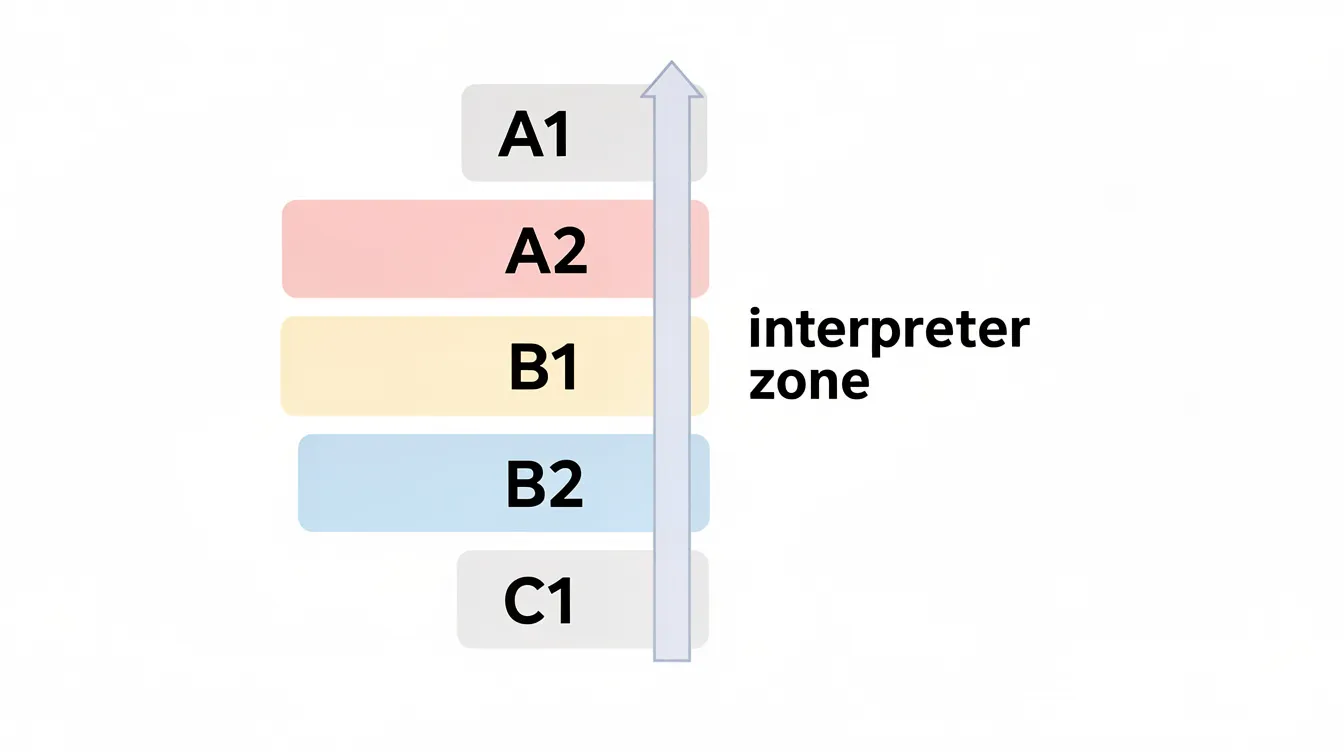
Proficiency involves high-level fluency in reading and writing for both languages - not just conversational comfort. On the CEFR, students should be at least Upper-Intermediate (B2) and preferably Advanced (C1) in both English and the target language.
This standard applies equally to medical interpreter training, court interpreter training, and interpreting for immigration courses. Healthcare settings, courtrooms, and immigration hearings leave zero room for language gaps. Engaging in professional interpreter training programs typically requires at least 40 hours of structured instruction - and that instruction assumes your baseline linguistic skills are already strong.
Our Oral Language Assessment Pre-Test: How We Verify Your Level
Before you start any course, you'll complete our Oral Language Assessment Pre-Test - a 15–25 minute language assessment conducted over the phone by a trained language coach in both English and your target language.
What we evaluate:
- Pronunciation and natural intonation
- Grammar accuracy (verb tenses, conditionals, complex sentence structures)
- Real-time listening comprehension at native speaker speed
- Vocabulary range, including everyday and semi-specialized terms
- Ability to sustain a natural, unscripted conversation
Sample tasks you might encounter:
- Summarize a short scenario you hear described aloud
- Narrate a past event using correct tenses and logical sequencing in both languages
This pre-test is a language proficiency test, not an interpreting skills exam. Its purpose is to confirm that applicants are ready to begin professional training. Self-assessment of language skills is encouraged before you schedule the call, so you walk in prepared.
Understanding CEFR, ILR, and ACTFL Levels for Interpreters
Three major frameworks define language proficiency levels worldwide. Here's how they relate to interpreters:
CEFR (Common European Framework of Reference for Languages)
The CEFR consists of six levels from A1 to C2. C2 is the highest proficiency level, indicating mastery at or near the native-speaker level. For interpreters, the relevant range is:
- B2 (Upper-Intermediate) - you handle most social and professional conversations with relatively high grammatical control, though errors still occur.
- C1 (Advanced) - you operate with few errors, strong idiomatic control, and can handle unfamiliar topics with flexibility.
- C2 (Proficient) - you understand virtually everything heard or read, and can express yourself spontaneously with precision.
Most professional interpreters operate between B2 and C1 or higher in both working languages.
ILR (Interagency Language Roundtable)
The ILR scale has five levels of language proficiency (plus sub-levels), widely used in U.S. government and legal contexts. Level 5 on the ILR scale indicates native or near-native proficiency. For professional interpreting, the target is typically ILR 3 (professional working proficiency) to ILR 4 (full professional working proficiency). Interpreters must achieve at least Level 3 proficiency to perform professionally in most settings.
The ILR skill level descriptions for spoken language distinguish between general conversational ability and the capacity to handle abstract, specialized, or adversarial speech - a critical distinction for court and medical work.
ACTFL (American Council on the Teaching of Foreign Languages)
ACTFL guidelines range from Novice to Distinguished. The oral proficiency interview (OPI) is the primary assessment tool, testing spontaneous, unrehearsed speaking skills.
Rough equivalences:
| CEFR | ILR | ACTFL |
|---|---|---|
| B2 | 2+ / 3 | Advanced Low/Mid |
| C1 | 3 / 3+ | Advanced High / Superior |
| C2 | 4 / 5 | Superior / Distinguished |
Interpreter Training Programs uses CEFR as the primary reference for our admissions process.
Is Native-Level Fluency Required, or Is Strong B2 Enough?
Let's address the article's central question directly: you do not need to be a native speaker in both languages to become a professional interpreter. But your proficiency in both must be demonstrably high, and interpreters should exceed the proficiency level required for their setting.
For safe, ethical interpreting in healthcare settings and courts, candidates should be at least high B2 and ideally C1 in both languages, even if only one is their mother tongue. Interpreter Training Programs does not require you to be perfectly native-like in both languages. However, your second language must feel effortless in everyday use and under time pressure.
Here's what B2 and C1 look like in practice:
- B2 - You follow most native speaker conversations but occasionally miss idioms, fast-paced speech, or regional accents. You can discuss complex topics, but sometimes pause to search for the right word. Research shows B2 speakers make roughly 6.7 grammatical/lexical errors per 100 words, which, in interpreting, can translate to clinically or legally significant mistakes.
- C1 - You understand fast, unscripted speech with minimal effort. You handle idioms, humor, register shifts (speaking to a judge vs. a five-year-old patient), and can explain complex ideas without frequent pauses. Error rates drop to about 1.9 per 100 words.
Higher language proficiency leads to faster processing in interpreting tasks - and speed matters when a doctor is explaining a treatment plan or an attorney is cross-examining a witness.
For example, a Portuguese–English interpreter whose native language is Portuguese but whose English is at CEFR C1 can work effectively in interpreting in healthcare or court interpreting with proper training. Interpreters need to convey meaning accurately and idiomatically, and C1 proficiency in a foreign language generally provides the foundation for that.

Why Interpreters Need Higher Language Proficiency Than Their Clients
A client with limited English proficiency may communicate at A2 or B1 in English. The interpreter serving that client must operate at a dramatically higher level. Here's why:
- Healthcare risk. In healthcare and medical interpreting, misunderstandings can affect diagnoses, treatment plans, and informed consent, which is why high language proficiency and interpreter training are critical in medical interpretation situations. Federal language access obligations under ACA Section 1557 and Title VI of the Civil Rights Act require covered entities to provide qualified medical interpreters - not just anyone who is bilingual.
- Legal consequences. In court interpreting, minor errors in tense, aspect, or register can change how testimony is perceived, directly affecting due process. A professional level of competence is non-negotiable.
- Immigration outcomes. In immigration interviews and hearings, precise rendering of dates, timelines, and conditional statements ("if I had known," "unless she leaves") can influence asylum or visa outcomes.
- Specialized vocabulary. Interpreters must handle idioms, slang, regional expressions, and specialized terminology comfortably. This is only possible with strong linguistic proficiency built over years of practice and immersion.
- Cultural competence. Cultural competence is essential for accurate interpretation in bilingual contexts - knowing when a patient is expressing pain indirectly, or when a witness is being evasive rather than confused.
Professional working proficiency is necessary to handle complex topics as an interpreter. Without it, the interpreter becomes the weakest link in conversations where lives, freedom, and rights are at stake.
Skill Profile for Medical, Court, and Immigration Interpreting
Different specializations demand different vocabulary, registers, and stamina. Here's what each track requires:
Medical Interpreting
Medical interpreter training prepares you for the language demands of hospitals and clinics:
- Anatomy and common diagnoses (hypertension, diabetic ketoacidosis, myocardial infarction)
- Medication names, dosages, and administration instructions
- Consent forms and advance directives
- Sensitive topics: mental health, end-of-life care, reproductive health
- Understanding specialized terminology in both languages is required for subject matter expertise in this field
Court Interpreting
Court interpreter training focuses on the legal system's formal register:
- Legal terminology: plea, arraignment, deposition, indictment, cross-examination
- Formal courtroom register alongside colloquial speech from witnesses
- Fast, adversarial questioning where every word counts
- Interpreting requires high concentration and stamina - a single hearing may run for hours
Immigration Interpreting
Interpreting for immigration covers USCIS interviews, credible fear hearings, and attorney-client conferences:
- Precise biographical and chronological language (dates, durations, sequences)
- Conditional and hypothetical statements common in asylum narratives
- Knowledge of subject matter enhances interpreting performance - familiarity with immigration law concepts helps you render testimony without hesitation
Interpreter Training Programs offers separate live Zoom courses in each of these areas so that already-proficient bilinguals from diverse professional backgrounds can build domain-specific competence. Candidates can also deepen their medical interpreting expertise with advanced medical interpreter training.
Do You Have to Read and Write Well, or Only Speak and Listen?
Speaking and listening are central for spoken language interpreters - but reading and writing can't be ignored.
Interpreters regularly encounter written materials on the job:
- Intake forms and lab reports in healthcare settings
- Court orders, motions, and charge sheets in legal proceedings
- Immigration documents, country condition reports, and interview notices in immigration situations
Strong literacy skills in both languages, not just one language, are part of "complete fluency" for interpreters. Accurate spelling of patient names, medication names, addresses, and dates matters during documentation and written correspondence related to assignments.
During courses from Interpreter Training Programs, students practice converting written text (e.g., discharge instructions, court notices) into spoken explanations. While our Oral Language Assessment Pre-Test focuses on oral proficiency, instructors expect participants to handle written materials comfortably from day one.
Self-Assessing Your Current Language Level Before You Apply
Before scheduling your pre-test, honestly assess where you stand. Here are practical ways to gauge your skill level:
- Use the CEFR self-assessment grid to estimate whether you're at B2 or higher in both English and your native language or second language.
- Listen to unscripted content. Can you follow talk radio, podcasts, or news broadcasts in your second language without subtitles or rewinding? If you catch 85–90% or more, you're likely at B2+.
- Test your speaking stamina. Can you argue your opinion on a complex topic - healthcare reform, immigration policy - for 5–10 minutes in your second language without switching to English?
- Check your grammar instincts. Do you use conditional tenses, subjunctive mood, and passive voice correctly without thinking? If you frequently second-guess basic grammar, you may need more general language practice first.
- Read a news article in each language and summarize it aloud in the other. If you can do this smoothly, your readiness for translation and interpretation is promising.
- Assess your vocabulary range. Are you able to understand complex topics and vocabulary in your second language? If not, domain-specific interpreter training will build that - but your general vocabulary needs to be significantly developed first.
If you often search for simple words or feel lost during fast conversations with a native speaker, consider a general language course to improve your foreign language proficiency before applying for professional interpreter training.
How Interpreter Training Programs Supports Your Growth Beyond Baseline Fluency
Once you pass the Oral Language Assessment Pre-Test, here's what you get:
- Live Zoom instruction with native-speaking instructors who provide real-time feedback on your language usage during interpreting practice - not pre-recorded videos you watch alone
- Progressive specialization that refines your language competence in specific registers
- Small-group classes where instructors catch and correct subtle issues in idiomatic expression, register, and terminology that general language courses usually miss
- Practical role-plays simulating real appointments, hearings, and depositions across different languages, helping students from other countries adapt to the U.S. interpreting landscape
AI and Language Tools: Can They Replace High Language Proficiency?
Machine translation and AI speech tools have developed rapidly, but they cannot replace a highly proficient human interpreter in high-stakes settings.
Here's why:
- Nuance and tone. AI struggles with sarcasm, cultural references, emotional register, and the idiomatic language that permeates real conversations between doctors and patients or attorneys and witnesses.
- Confidentiality. Many hospitals, courts, and immigration venues restrict the use of recording devices and cloud-based tools for privacy and compliance reasons.
- Legal requirements. The 2024 Section 1557 final rule and Title VI continue to require qualified human interpreters. Machine translation may support terminology lookup, but it cannot serve as a substitute for a qualified interpreter in clinical or legal communication.
Interpreter Training Programs incorporates discussion of technology and best practices so students can be familiar with AI tools and use them appropriately - for preparation and terminology research - without compromising ethics, accuracy, or the mastery that clients depend on.
Career Paths Once Your Language Proficiency Is Ready
Strong bilinguals who complete interpreter training open the door to a range of career paths:
- Staff healthcare interpreter at a hospital or health system
- Freelance court interpreter working across multiple jurisdictions
- Contractor for immigration law firms handling asylum and visa cases
- Video remote interpreter (VRI) for national language service companies - work from home in your language pair
- Government or national security interpreter for federal agencies
U.S. Bureau of Labor Statistics projections through 2032 show continued growth in interpreter and translator employment, especially in healthcare and legal services. Higher linguistic skills and specialization typically correlate with better pay, more stable contracts, and access to assignments in a particular language pair that fewer interpreters can fill.
If you're already a strong bilingual - whether Spanish, Mandarin, Arabic, Portuguese, or another language - interpreter training is a direct path to professionalizing your existing knowledge and serving multilingual communities where the need is urgent and growing.
Conclusion: Is Your Fluency Ready for Interpreter Training?
Interpreters do not need to be native in both languages. But they must demonstrate high, testable language proficiency - at B2 minimum, C1 preferred - in both English and their target language. Language proficiency is foundational for effective interpretation beyond basic bilingualism - every framework from CEFR to the ILR scale to the ACTFL scale confirms this.
The path forward is straightforward:
- Assess your level honestly using the self-check questions above
- Pass the Oral Language Assessment Pre-Test with Interpreter Training Programs
- Build specialized interpreting skills through structured, live training in your chosen field
Every accurate interpretation you deliver has the power to communicate a diagnosis, a verdict, or an asylum outcome. If your language proficiency is ready, your community needs you.
Ready to find out where you stand? Schedule your Oral Language Assessment Pre-Test or contact Interpreter Training Programs to discuss which course fits your goals.
Our online translator classes are taught by expert instructors  who have real-world experience in their interpreting specialty. They have worked hard to make fully remote online courses that are unique and engaging using a hands-on approach that is unparalleled by the competition. If you or someone you know is interested in our online Medical Interpreter Training Programs with live instruction, our fully remote yet real time classes are offered in Spanish, Portuguese, Arabic, Russian, Chinese, Haitian Creole, Vietnamese, Farsi, French, Hindi, Korean, Somali, Urdu, Ukrainian, languages online and onsite.
Frequently Asked Questions
Do you need to be a native speaker to become an interpreter?
No. You don't need to be a native speaker of both languages, but your proficiency in both must be high and testable. For medical, court, and immigration interpreting, you should be at least a high B2 and ideally C1 on the CEFR scale in English and your target language.
What language level do you need to become a professional interpreter?
Most professional interpreters work at CEFR B2 to C1 or higher in both languages. On the ILR scale used in U.S. government and legal settings, the typical target is Level 3 (professional working proficiency) or above.
Can interpreter training teach me a second language?
No. Interpreter training teaches you how to interpret professionally in languages you already speak fluently. Applicants to Interpreter Training Programs must be fully bilingual in English and their target language before enrolling.
What is the Oral Language Assessment Pre-Test?
It's a 15–25 minute phone assessment conducted by a trained language coach in both English and your target language. It evaluates pronunciation, grammar, listening comprehension, vocabulary, and conversation skills. It's a language proficiency test, not an interpreting skills exam.
Do interpreters need to read and write well, or just speak?
Interpreters need strong reading and writing skills in both languages. On the job, they regularly encounter written materials like intake forms, lab reports, court orders, and immigration documents, and they need to accurately spell names, medications, addresses, and dates.
How can I tell if my language skills are ready for interpreter training?
Try following unscripted podcasts or news in your second language without subtitles, discussing a complex topic for 5–10 minutes without switching languages, and summarizing a news article aloud in your other language. The CEFR self-assessment grid can also help you estimate your level.


